
The Shopsmith and the Habit of Agency
Your agency lives in your hands

A Shopsmith is an all-in-one woodworking tool, combining at minimum a table saw, lathe, drill press, sander, and horizontal boring machine, with some models offering attachments for more tools like band saws and jointers. The original model was designed in the late 1940s and mass-marketed to America’s new class of suburban homeowners, many of whom had recently worked on a similar array of machine tools in the armed services or war industries. My father had one—inherited from his father, who had served as an aircraft mechanic on a carrier in the Pacific Theatre—and while he was more than a casual hobbyist and boasted a full wood shop in our garage, he could do a lot on that single machine. Much of the furniture in our home was his work, and unless a home repair got too deep into the weeds of plumbing or electrical issues, he could usually accomplish it himself. When I was a teenager, he even ran a side business restoring and repairing older Shopsmiths, which hold up surprisingly well to decades of use. Shopsmith the company still exists, and you can still purchase their newest model for $5,995; the company has been through several sales and restructurings though, and one gets the sense that it’s a much more niche market than it was in its mid-century heyday.
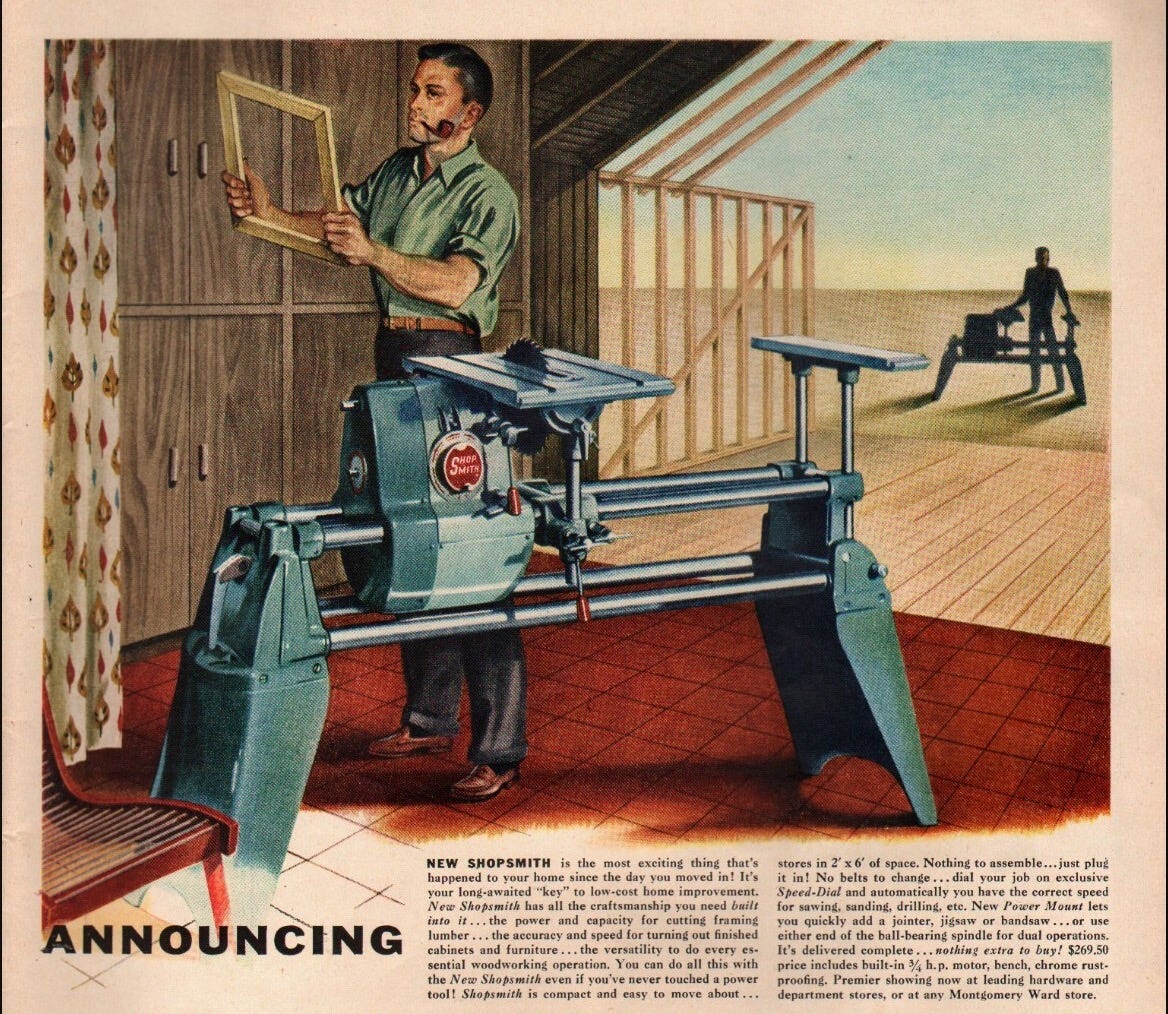
My paternal grandfather was not at all out of the ordinary for his generation when he purchased a miniature machine shop to keep in his garage; even outside of home repairs, his generation was still full of people who worked in factories, making things—or at least parts of things—with their hands. Around the same time, my maternal grandfather was building his own house with the help of family and friends, because that region of Appalachia was not yet producing enough surplus for “builder” to emerge as a fully specialised profession. My father is on the “handy” end of the baby-boomer spectrum, but by no means exceptionally out of distribution; among the millennials and zoomers in my peer group, things are rather different. There is a pattern of life I have noticed among so many of us that goes something like this: we work “laptop jobs” with little or no physicality in a walled-garden OS whose affordances we did not choose and cannot change. We come home to a new-build apartment with no sharp edges—or a room in an ancient townhouse in a desirable metro where nothing quite works anymore—but in neither case are we permitted to alter the environment much beyond hanging things on the walls. We buy finished products from Ikea or Amazon and when they break we replace them. Perhaps we cook, some of us build lego sets to collect dust on the shelves, and the most creatively inclined among us might knit, paint Warhammer miniatures, or CAD shapes to be printed in soft plastic. Strictly speaking, this is all very efficient; I suspect that it is making us insane.
The most “primitive” human cultures made tools, but for the most part did not durably modify their environments. At most they produced temporary shelters, painted on cave walls, or turned open spaces into temporary open-air megafauna butcheries. One of the hallmarks of settled society and early civilisations was, in fact, the more durable modification of a continuous living space. Civilisation has always meant houses, storerooms, temples, fortifications, canals, and for the vast majority of human history, most people built these for themselves or at least participated in their construction or upkeep. This distribution of skills was also an affordance of agency—people who could construct sufficient shelter for themselves could go elsewhere and do so again if conditions became intolerable, like when refugees fleeing invasion drove piles into the soft floor of the lagoon outside Ravenna and built a city on the water, or when Ulstermen embarked by the thousands to carve out homesteads in the North American wilderness. Even in more recent periods—when growing state capacity and diminishing supplies of “terra nullius” effectively eliminated the possibility of wholesale migration as political action—we could at least collectively imagine large-scale qualitative alterations to the environment. In the early to mid twentieth century we built the great townhouse and skyscraper cities of North America, and then, deciding we were unsatisfied with those, invented the modern suburb and highway system out of whole cloth.
When I talk to my “normie” coworkers today about, for example, basic YIMBY and transit politics, I am very rarely met with anything like hostility or even skepticism. The first response I get is almost always surprise—surprise that the ordering of the built environment is a topic that could be debated at all. One gets the sense, talking to most people, that they accept the built environment as a given almost like they accept gravity. This, I think, is a significant hurdle for YIMBY politics and leads to the popular fallacy that the housing crisis is a problem of distribution rather than supply, but I suspect that the problem I’m identifying goes much farther than a singular issue or even the built environment itself. It is a truism of self-help books that habit trumps willpower; the brain is like a muscle and can be trained to new habits, and indeed it must be, if one wants to change course. My suspicion is not only that people who don’t modify their surroundings lose the ability to imagine the built environment as changeable, but that physical engagement with the immediate environment is the most basic form of agency—and that to forgo it is to forgo the habit of agency altogether.
Agency is the ability to take action and make choices, but we do not make choices for their own sake—we make them in pursuit of some outcome. Physically interacting with one’s surroundings—making and using tools, altering the environment around us—is the most basic form of agency and choice making, and when it comes to developing the habit, this practice of “physical agency” has the unique advantage of immediate gratification; the results are literally and immediately in one’s hands. As one develops such physical skills, one acquires the capacity not just to alter the environment around one but to make it more beautiful and comfortable, and with this capacity comes a measure of discernment and self-confidence. Some of the first toys we give children who have progressed beyond the “identifying objects” stage of infancy are building blocks and non-toxic craft supplies, toys which help us learn this physical agency. And yet many of us never progress beyond this toddler stage; all too soon we are whisked away to school work in which all productivity is abstracted as symbols on paper or worse yet on a screen. As adults we work jobs where others tell us what to do, and the primary way we express agency over our physical experience is by buying things pre-made. Sometimes, if we are poor or pressed for time we will modify or repair these things—as shown in all those short form videos of “life hacks”—but the results will feel janky and look ugly and we internalise that nothing we make ourselves will stand up to the object that comes to us from a faceless entity through the monetary medium of exchange.
And then, suddenly, one is promoted to management and asked to “take ownership”, or one is asked a political question, or one realises that one is deeply dissatisfied with one’s life in a way that demands a choice. But how can one make a choice when one has lost the habit of it? At best, we are used to making choices as consumers, the choice of buying this thing or that thing, and so we are conditioned to understand each of our choices as one of selecting from pre-made options rather than of active and creative construction. We have deprived ourselves of the habit of embodied agency with immediate feedback loops, and yet expect ourselves to be capable of exercising it well in the abstract for delayed gratification—like a person who has never walked more than half a mile in a day expecting to run a marathon. Civilisation, and especially our egalitarian, small-r republican form of it, has always depended on a broad base of people capable of making choices and actively constructing the reality they want to live in; and I have increasingly come to believe that the breakdowns in our social order are in large part downstream of a people who have lost this habit of agency.
I do not have a Shopsmith or build my own furniture, and I only occasionally employ the atrophied home-repair skills that my father tried to impart. I do, however, tie people up. Shibari and the wider practice of rope bondage requires a significant degree of manual skill and involves taking a great deal of responsibility for another person’s wellbeing; when executed well it produces something beautiful. This is, at least, a start, and I have noticed that since beginning to engage with the practice seriously my own waterline of sanity and self-confidence has increased. If you’re trying to build up your own sense of agency, consider starting with something that you can hold in your hands, something that builds to acts of creation and choice rather than pure pattern-following or maintenance, and something that adds beauty and utility to your life.